In midlife, we begin to notice something subtle.
The trips that stay with us are rarely the busiest ones.
They are not always the cities where we “did the most.”
They are not necessarily the itineraries packed from morning to night.
Instead, they are often the quiet walks.
The slow breakfasts.
The unhurried conversations.
The still moments when nothing dramatic happened — yet something meaningful settled inside us.
Slower travel experiences tend to create stronger memories because they give the mind time to register what is happening.
And registration is what turns experience into memory.
Memory Is Built in the Spaces Between
When we rush from landmark to landmark, the brain shifts into task mode.
It focuses on navigation.
Timing.
Logistics.
Next steps.
But memory deepens when the nervous system feels safe and unhurried.
Slower experiences allow:
• Emotional processing
• Sensory absorption
• Reflective thought
• Presence without pressure
The mind needs margin.
Without margin, moments blur together.
With margin, they root.
Slowness Supports Energy Preservation
From an energy and resilience perspective, slower travel also protects something vital in midlife: recovery capacity.
After 50, sustainable energy management matters more than performance.
A slower pace allows:
• Stable walking rhythm
• Gentle strength usage instead of constant strain
• Fewer cortisol spikes
• Better sleep quality
• Steadier digestion
• Emotional steadiness
When the body feels regulated, the mind encodes experiences more clearly.
This is not accidental.
It is biological.
The Walking Advantage
Walking remains one of the most powerful pillars of midlife travel.
Not rushed walking.
Not “step target” walking.
But observant walking.
The kind where:
• You notice architectural details
• You pause at a doorway
• You hear distant conversations
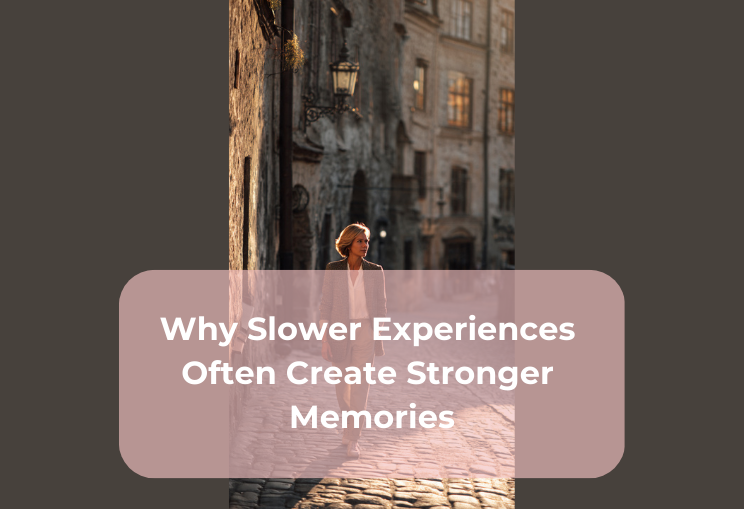
• You feel the texture of cobblestones
Mobility and stability are strengthened through this rhythm — but so is memory.
The slower the walk, the more layered the experience.
Stronger Memories Come From Emotional Anchors
Fast travel creates snapshots.
Slow travel creates emotional anchors.
An emotional anchor might be:
• A café you returned to three mornings in a row
• A park bench that became your thinking place
• A conversation that unfolded without checking the time
• The smell of rain in a quiet street
Repetition strengthens memory pathways.
And slowness allows repetition.
Intentional Travel vs. Exhaustion Travel
There is a difference between exploration and overconsumption.
Intentional travel asks:
What do I actually want to feel on this trip?
Calm?
Renewal?
Curiosity?
Strength?
When you choose fewer experiences and inhabit them fully, the mind integrates them more deeply.
This supports long-term wellbeing rather than short-term stimulation.
Reflection Is the Multiplier
One quiet evening reflection can double the depth of a day.
Even five minutes asking:
• What stood out today?
• What did I feel?
• What surprised me?
Reflection moves experience from surface level to narrative memory.
And narrative memory is what lasts.
The Midlife Advantage
Here is something important.
In midlife, we no longer need to prove anything.
We are not collecting experiences for external validation.
We are choosing experiences for internal meaning.
That shift alone naturally slows the pace.
And in slowing, we strengthen.
Slower Does Not Mean Smaller
Slower travel does not mean less meaningful.
It means more integrated.
It means:
• Energy preserved
• Strength maintained
• Mobility respected
• Stability reinforced
• Nutrition enjoyed rather than rushed
• Recovery prioritized
These pillars compound.
And so do memories.
Depth Carries Forward
The strongest memories are rarely loud.
They are steady.
They are textured.
They are felt in the body as much as remembered in the mind.
When you slow down, you do not reduce the value of travel.
You deepen it.
And depth — not speed — is what carries forward into the years ahead.