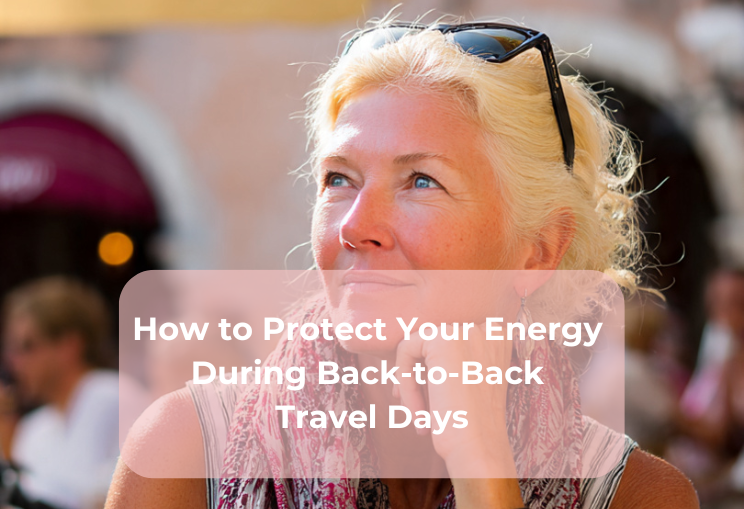
Consecutive Travel Days Require a Different Approach
Back-to-back travel days place a unique demand on the body and mind.
Early starts.
Long journeys.
Changing environments.
Constant decision-making.
Even enjoyable travel can become draining when there’s little recovery between days.
Protecting your energy during these stretches isn’t about doing less — it’s about supporting yourself more intentionally.
Energy Drain Is Often Cumulative, Not Immediate
Most travel fatigue doesn’t hit all at once.
It builds quietly:
- Small sleep disruptions
- Irregular meals
- Prolonged sitting or standing
- Continuous stimulation
- Reduced downtime
By the time exhaustion shows up, it’s often already layered.
That’s why energy protection works best before you feel depleted.
Midlife Makes Energy Protection Essential, Not Optional
In midlife, recovery takes longer — and ignoring that reality comes at a cost.
This isn’t weakness.
It’s physiology.
When you respect your energy limits:
- Travel stays enjoyable
- Focus remains clearer
- Mood stays steadier
- Health is preserved
Energy protection becomes a form of self-respect.
Anchor Habits Become Non-Negotiable on Travel Days
During consecutive travel days, simplicity matters.
Choose a few anchor habits and protect them:
- Hydration early and often
- Light, nourishing meals
- Gentle movement (walking, stretching)
- Brief quiet moments between transitions
- Consistent wind-down in the evening
These anchors stabilise your system when everything else is changing.
Reduce Decisions Wherever Possible
Decision fatigue is a major energy drain during travel.
You can reduce it by:
- Wearing simple, repeatable outfits
- Pre-deciding meals where possible
- Limiting digital inputs
- Keeping daily plans minimal
- Letting go of non-essential tasks
Less decision-making leaves more energy for the experience itself.
Movement and Rest Must Coexist
Long travel days often involve extended sitting — followed by overstimulation.
Balance matters:
- Short walks instead of long workouts
- Gentle stretches rather than intense exercise
- Rest without screens when possible
Movement keeps energy circulating.
Rest allows it to recover.
Calm Thinking Preserves Energy Better Than Pushing
Trying to “power through” consecutive travel days often backfires.
Calm pacing:
- Prevents crashes
- Keeps the nervous system regulated
- Improves sleep quality
- Makes travel feel lighter
Energy lasts longer when it isn’t forced.
Travel Enjoyment Depends on Energy Management
Protected energy changes how travel feels.
You:
- Notice more
- Feel less rushed
- Recover faster
- Enjoy the journey instead of enduring it
Back-to-back travel doesn’t have to mean burnout — when energy is treated as a priority.
Protect Your Energy
Energy isn’t something to spend recklessly during travel.
It’s something to manage thoughtfully.
When you protect your energy on back-to-back travel days, travel remains expansive rather than exhausting — and freedom continues to feel like freedom.