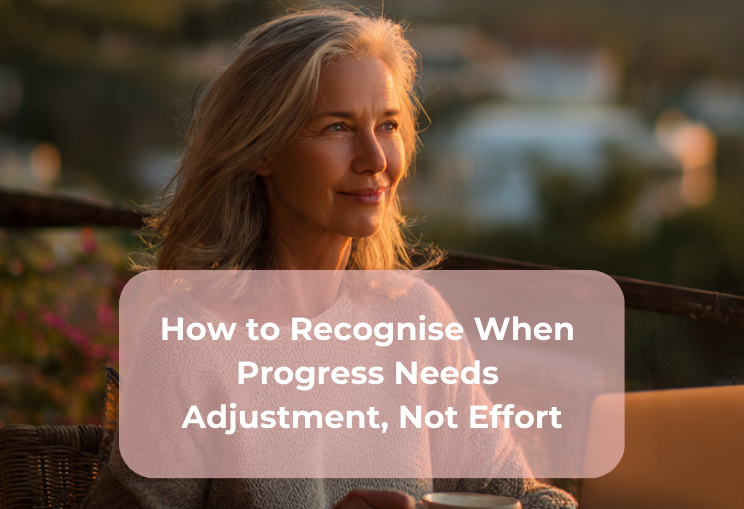
More Effort Isn’t Always the Answer
When progress slows, most people assume the solution is simple:
Work harder.
Push more.
Add effort.
But sustainable growth rarely works that way.
Sometimes progress doesn’t need more effort — it needs adjustment.
Recognising the difference protects energy and prevents burnout.
Signs That Effort Isn’t the Problem
If you’re already:
- Showing up consistently
- Following a structured routine
- Protecting your focus
- Taking reasonable action
Yet results feel stagnant…
The issue may not be effort. It may be alignment.
The Hidden Cost of Pushing Harder
When you increase effort without adjustment:
- Stress rises
- Recovery declines
- Frustration builds
- Confidence weakens
You may temporarily increase output, but sustainability suffers.
Progress built on strain rarely lasts.
Adjustment Is a Strategic Move, Not a Retreat
Adjustment means refining:
- Your pace
- Your schedule
- Your expectations
- Your travel plans
- Your financial systems
- Your workload balance
Adjustment requires awareness — not weakness.
It’s a sign of maturity.
Travel Teaches the Power of Adjustment
Travel naturally requires adjustment.
You may:
- Change plans due to weather
- Shift sightseeing schedules
- Add recovery days
- Simplify logistics
When travellers adjust instead of forcing plans, trips feel calmer and more enjoyable.
The same principle applies to life and income.
Midlife Encourages Smarter Adjustment
In midlife:
- Energy patterns shift
- Priorities clarify
- Capacity changes
What once worked may no longer fit.
Adjusting to your current reality is not giving up — it’s evolving.
How to Evaluate the Need for Adjustment
Ask yourself:
- Am I pushing harder than necessary?
- Has my capacity changed?
- Are my expectations outdated?
- Does my routine still fit my lifestyle?
- Is the friction I’m experiencing structural rather than motivational?
These questions reveal whether effort or refinement is needed.
Small Adjustments Often Create Big Shifts
Sometimes progress improves when you:
- Reduce daily targets
- Narrow focus
- Improve sleep
- Simplify systems
- Build financial predictability
- Protect mental bandwidth
Small refinements restore momentum without strain.
Sustainable Success Is Adaptive
The most sustainable lifestyles are not rigid.
They adapt gradually.
They respond to energy shifts, life changes, and new information without panic.
That flexibility preserves confidence.
TravelWell LiveGood and Calm Adjustment
The TravelWell LiveGood philosophy supports:
- Calm reassessment
- Gentle course correction
- Energy-aware growth
- Stable long-term thinking
This creates freedom that feels secure — not forced.
Moving Smarter
When progress slows, effort isn’t always the solution.
Sometimes the wisest move is adjustment.
Recognising the difference protects your energy, strengthens sustainability, and keeps growth aligned with your current capacity.
That’s not slowing down.
That’s moving smarter.